



Streamlining Project and Permission Management with UDT
Automated Testing 2025-03-12 15:12 424
Automated testing not only improves collaboration and task tracking, effective management also helps in optimizing workflow, ensuring that tasks are carried out in a timely manner and that each project progresses smoothly.
Automated testing involves a wide array of resources, including devices, test cases, and team members. Managing these resources, especially in large and complex projects, can be challenging without a structured approach. Efficient project and permission management plays a crucial role in ensuring that every member of the team has access to the right resources, at the right time, while protecting the security and integrity of the testing environment.
In addition to improving collaboration and task tracking, effective management also helps in optimizing workflow, ensuring that tasks are carried out in a timely manner and that each project progresses smoothly. UDT's built-in tools for managing projects and permissions address these needs by centralizing operations, offering flexibility, and ensuring clarity in team roles.
UDT's Project Management Capability
WeTest UDT simplifies project management by providing features that centralize testing activities under one roof. These features allow teams to collaborate effortlessly, track progress, and configure project settings according to their needs.
1. Project Basic Settings
UDT enables teams to define the basic settings of their projects, allowing for customized project names, descriptions, and icons. This flexibility ensures that every project is uniquely identifiable and tailored to its specific requirements. Additionally, project visibility settings give administrators control over who can view and access the project, making it easier to manage collaborations and secure sensitive information.
The ability to adjust project settings also helps align testing efforts with the overall goals of the organization, ensuring that all testing activities are in line with business priorities.
2. Task and Test Case Management
With UDT, managing test cases and tasks within a project becomes a streamlined process. Teams can organize and track testing activities and monitor the completion of each task. The system ensures that no tasks are overlooked, and testing is always conducted efficiently and within the project's timeline.
By centralizing task management, UDT reduces the risk of missed deadlines and disorganized workflows. Teams can easily keep track of ongoing testing efforts and quickly adapt to any changes in the project scope or timeline.
Efficient Project Member and Permission Management
UDT takes the complexity out of managing project members and their respective permissions. The platform allows team leaders to assign specific roles and responsibilities, ensuring clear ownership and accountability.
1. Project Member Management
Managing team members within a project is made simple with UDT's intuitive tools. Administrators can add or remove members, edit roles, and track project contributions. By assigning roles such as "administrator" or "regular member," teams can quickly designate responsibilities, ensuring that the right person is in charge of specific tasks.
With this role-based structure, UDT ensures that the project operates smoothly, and team members can focus on their designated responsibilities without confusion or overlap. The flexibility to change roles as the project evolves makes it easy to accommodate team changes without disrupting the workflow.
2. Permission Management
One of UDT's standout features is its robust permission management system, which allows administrators to set detailed permissions for regular members based on their role in the project. Permissions can be customized for specific actions such as project management, task execution, application usage, and testing operations.
This granular control over permissions ensures that each team member has access to only the tools and information they need to perform their tasks. By preventing unauthorized access to sensitive data or critical project components, UDT helps maintain the security and integrity of the testing environment.
The ability to assign permissions based on task requirements also reduces the risk of errors, as each member is empowered to perform only the functions within their scope. This keeps the workflow organized, while minimizing the chances of accidental changes or data breaches.
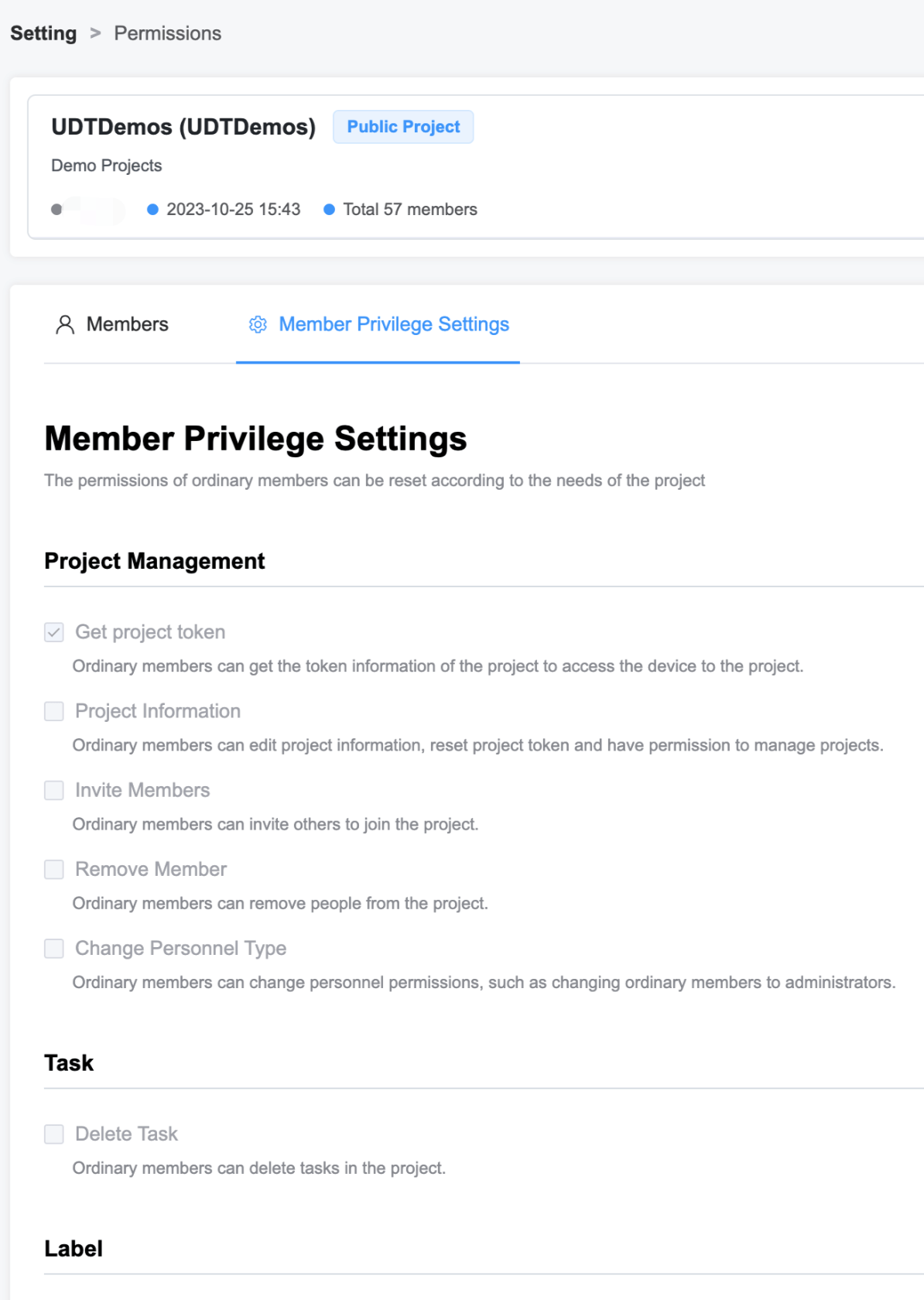
3. Flexible Permission System Customization
UDT empowers enterprises to fully customize functional permissions beyond predefined roles, allowing tailored control over specific capabilities. Each function, whether prebuilt or custom-added, supports configurable operational scopes (full control/read-only/approval workflows) and data isolation rules. This ensures every permission dimension, down to individual platform features, aligns precisely with evolving business requirements and compliance standards.
Conclusion
Centralizing project management and member roles helps eliminate confusion and miscommunication. Teams can track project progress, allocate resources efficiently, and adjust quickly to changes in scope or priorities.
For businesses looking to optimize their project workflows and enhance team coordination, UDT provides a comprehensive and secure solution that adapts to their needs. By centralizing project management and offering granular control over permissions, UDT ensures smoother testing processes and more efficient team collaboration.
Start Your Free Trial on UDT
1. Register to get your UDT account
2. Create a new project in your account
3. Contact us to get free real devices in your project
Also, we are glad to have a meeting with you: Schedule a Meeting with Us
Learn more about UDT platform: WeTest-All Test in WeTest
UDT Demo: WeTest-All Test in WeTest
0
Latest Posts
1GB/T 48140–2026: China's New Automotive Software Quality Standard Explained China's GB/T 48140–2026 redefines automotive software quality management across the full lifecycle. Explore its impact on OTA updates, AI testing, and continuous validation.
2Tencent WeTest at Devcom: Two New AI Testing Solutions, From Fixed Scripts to Autonomous Agents Discover how Tencent WeTest leverages Acorn AI and a reusable visual Agent architecture to transform game QA into an autonomous, closed-loop diagnostic system.
3AI Coding Agents Enter the Testing Loop: From Code Generation to Automated Debugging AI coding agents are evolving from code generators to full software engineering agents that test, debug, and fix code. Learn how runtime context enables automated root cause analysis and why testing becomes more critical than ever.
4Test Management: Practical Lessons for Engineering Team Leads Learn proven test management strategies for technical leaders, including team efficiency optimization, project planning, knowledge accumulation, QCC improvement, and practical team building methods.
5The Path to Test Development: 7 Core Competencies for Modern QA Engineers What makes a senior QA engineer stand out? Explore the 7 core QA competencies including quality-driven execution, team influence, risk governance, process improvement, and technical fundamentals for modern software testing.
Tools
UDT: Auto-Testing Platform
Customized Auto-Testing Platform
Real Device Cloud
PerfDog
CrashSight
PerfSight
Featured Services
APP Compatibility Testing
APP Functional Testing
Mobile Game Hardening
Penetration Testing
Crowd Testing
Localization Quality Assurance
Featured Solutions
Mobile Game Solutions
PC Game Solutions
Overseas Local User Testing Solutions
Mini Program Security Testing Solutions
ISO 9001:2015
Quality Management System Certification
ISO/IEC 20000-1:2018
IT Service Management System Certification
ISO/IEC 27001:2013
ISO/IEC 27001:2013
Copyright © 1998 - 2025 Top Range Mobile Limited.(WeTest.net) All Rights Reserved
