



 Real Device
Instant access to a wide range of iOS and Android real devices
Real Device
Instant access to a wide range of iOS and Android real devices
Learn More
Pricing
Leveraging big data from its testing platform and integrating the latest figures from 2021, Tencent WeTest reveals the current distribution of mobile devices across the market, analyzing dimensions such as RAM, hardware configuration, and screen specifications.
Viewing 2021 as a whole, devices with over 6GB RAM were mainstream in the market. Their coverage continues to grow, with user share reaching 65.3% (up from 50.1% in 2020). Among these, 8GB models have the widest user coverage, accounting for 36.3%. Meanwhile, the user share for 4GB models dropped to 24.1% (down from 37.6% in 2020), and models with less than 3GB of RAM now account for only 2.3% of users.
In the report's sample of the Android TOP 500 (the 500 models with the highest market share based on the WeTest adaptation index), the trend is similar: models with over 6GB of RAM have the highest user coverage at 68.4%. Specifically, 6GB models account for 27.4%, while 8GB models saw a significant increase from 19% last year to 38.2%. Among models with less than 6GB of RAM, the share of 4GB models fell to 25.6% (from 32.2% in 2020), while 3GB and 2GB models accounted for only 4.8% and 1.2%, respectively.
Additionally, looking at new models launched in 2021 (as of December), 8GB RAM models ranked first, comprising 45.8% of new releases. These were followed by 6GB and 4GB devices, while new models with 12GB of RAM accounted for 5.8%.
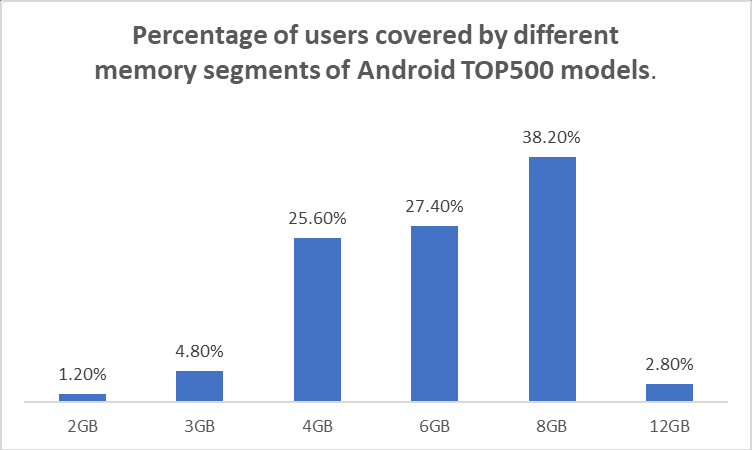
(Chart 1: User Coverage by RAM Segment for Android TOP 500 Models)
In 2021, within the Android TOP 500, FHD+ screens (resolutions exceeding 1920×1080 but not reaching 2K) were the absolute mainstream, accounting for a massive 69.2%. Resolutions of 2K and above have not yet become ubiquitous, totaling only 10%. The standard 1920×1080 resolution continued its decline, dropping from 12.9% last year to 7.6%.
Within the FHD+ category, the 2340×1080 resolution—which ranked first last year—saw a significant drop to 24% (down from 31.4% in 2020). Conversely, the 2400×1080 resolution saw a sharp increase, rising from 8.7% last year to 25.6%.
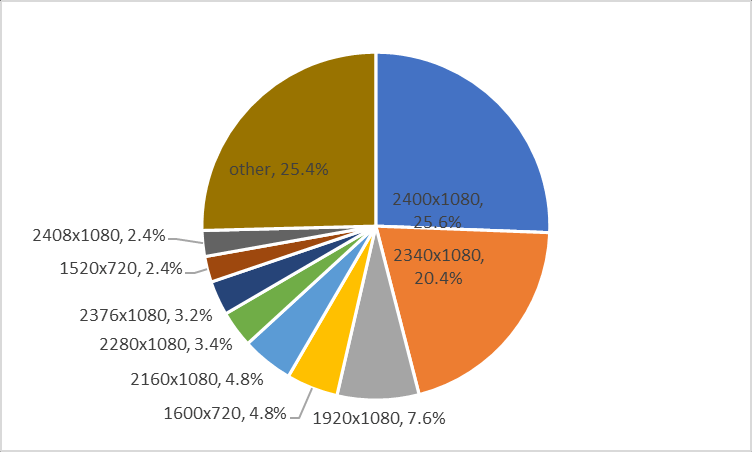
(Chart 2: Device Resolution Share for Android TOP 500 Models)
In 2021, the configuration of mainstream models in the Android TOP 500 steadily improved. The share of 8-core CPU models increased further, rising from 96.3% last year to 98.4%. In contrast, non-8-core devices accounted for a combined total of only 1.6%. Mobile core counts have stabilized at eight, with no trend toward further increases.
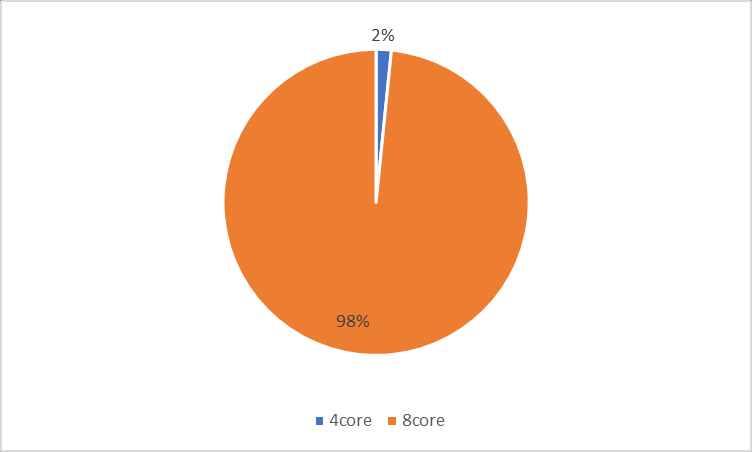
(Chart 3: Core Count Distribution for Android TOP 500 Models)
Regarding CPU frequency, models clocking between 2.0–2.5GHz dropped from 50.1% last year to 36%. However, models clocking at 2.5GHz and above rose from 22% to 43%, marking the second consecutive year of substantial growth (up from 14% in 2019). Models under 2.0GHz dropped from 27.9% to 21%.
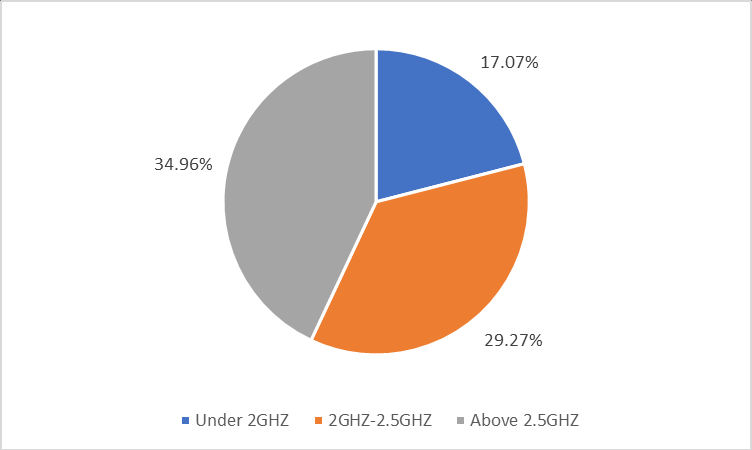
(Chart 4: CPU Frequency Distribution for Android TOP 500 Models)
Looking at the leading CPU and GPU manufacturers, mid-to-high-end chips remain the mainstream. In the Android TOP 500, regarding System-on-Chip (SoC) vendors, Qualcomm holds a significant lead over other manufacturers with a 51.6% share. This is followed by MediaTek at 24% and HiSilicon Kirin at 22.8%. The market is essentially dominated by Qualcomm's Adreno and ARM's Mali GPUs, with shares of 51.6% and 43.8% respectively. PowerVR GPUs are used less frequently on Android devices but saw a slight increase over last year to 4.6%.
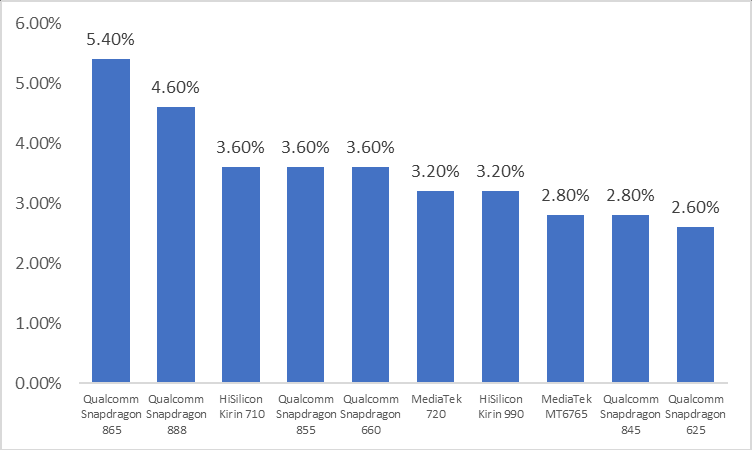
(Chart 5: Android TOP 10 CPU Share)
Furthermore, among new models launched in 2021 (as of December), the Adreno 660 was the top-ranked GPU with a 17.1% share. The Qualcomm Snapdragon 888 was the number one CPU processor, accounting for 10.1%. Notably, 66.1% of these models support 5G networks, and the prevalence of non-standard screens (e.g., notches, punch-holes) reached 94.2%.
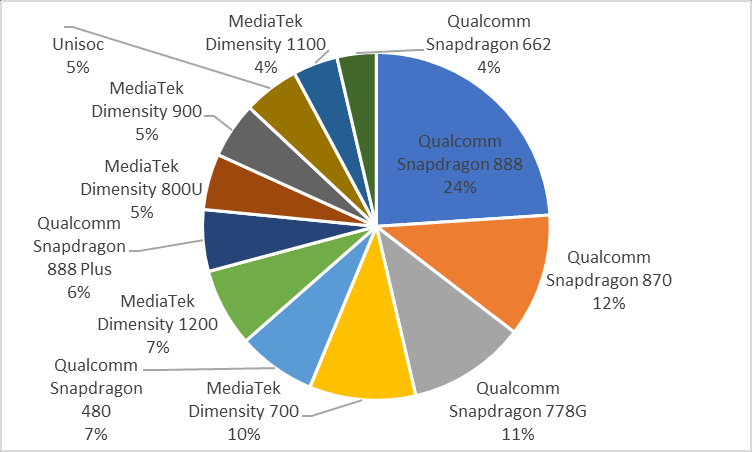
(Chart 6: CPU Share for New 2021 Models)
Note for Developers: When adapting for newly released models, pay close attention to UI issues caused by non-standard screen shapes.
Overall, mobile hardware saw further upgrades in 2021. Devices characterized by the Qualcomm Snapdragon 888, 8GB RAM, and FHD+ screens have become the mainstream. Additionally, with the accelerated rollout of 5G networks, the market share of 5G phones will continue to expand, making their specific application scenarios a key focus for developers.
